
PREFORMULATION
STUDIES
PHYSICAL AND ORGANOLEPTIC
PROPERTIES OF TIZANIDINE
|
PROPERTIES
|
SPECIFICATIONS
|
|
Colour
|
White
to off-white
|
|
Appearance
|
fine
crystalline powder
|
|
Odour
|
Odourless or faint characteristics
odour
|
ASSAY
OF RAW MATERIAL OF TIZANIDINE MUCOADHESIVE TABLET
PROCEDURE
Solution
A:
6.8 mg/mL of monobasic potassium phosphate. Adjust with 5.3N potassium
hydroxide to a pH of 7.5 ± 0.05.
Mobile
phase:
Acetonitrile and Solution A (20:80)
System
suitability solution:
46 mg/mL of USP Tizanidine Hydrochloride RS and 0.12 mg/mL of USP Tizanidine
Related
Compound C RS in Mobile phase
Standard
solution:
0.046 mg/mL of USP Tizanidine Hydrochloride RS in Mobile phase
Sample
solution:
0.046 mg/mL of Tizanidine Hydrochloride in Mobile phase.
Chromatographic
system:
(See Chromatography (621),
System Suitability.)
Mode: LC
Detector: UV 230 nm
Column: 4.6-mm ´ 15-cm;
packing L7
Column
temperature:
35°
Flow
rate:
1 mL/min
Injection
size:
20 mL
System
suitability
Sample: Standard solution
[NOTE—The relative retention
times for tizanidine related compound C and tizanidine are 0.5 and 1.0,
respectively.]
Suitability
requirements
Resolution: NLT 13.0
between tizanidine and tizanidine related compound C
Tailing
factor: NMT
1.6 for tizanidine
Relative
standard deviation:
NMT 2.0%
Analysis
Samples: Standard solution and Sample solution Calculate the
percentage of C9H8ClN5S · HCl in the portion of Tizanidine Hydrochloride taken:
Result
= (rU/rS) ´ (CS/CU) ´ 100
rU = peak response of tizanidine
from the Sample solution.
rS= peak response of tizanidine
from the Standard solution
CS = concentration of USP
Tizanidine Hydrochloride RS in the Standard
solution (mg/mL)
CU = concentration of the Sample solution (mg/mL)
Acceptance criteria: 98.0%–102.0%
(8)
DETERMINATION OF BULK
DENSITY OF RAW MATERIAL
Bulk density is
defines as weight per unit volume of material.Bulk density is determined by measuring the
volume of a known mass of powder sample that has been passed through a screen
into a graduated cylinder (Method I)
or through a volume-measuring apparatus into a cup (Method II).
Method—Measurement in a Graduated Cylinder
Procedure
·
Unless
otherwise specified, pass a quantity of material sufficient to complete the
test through a 1.00-mm (No. 18) screen to break up agglomerates that may have
formed during storage. Into a dry 250-mL cylinder introduce, without
compacting, approximately 100 g of test sample, M,
weighed with 0.1% accuracy.
·
If it is
not possible to use 100 g, the amount of the test sample and the volume of the cylinder
may be modified and the test conditions specified with the results. Select a
sample mass having an untapped apparent volume of 150 to 250 mL. A 100-mL
cylinder is used for apparent volumes between 50 mL and 100 mL. Carefully level
the powder without compacting, if necessary, and read the unsettled apparent
volume, Vo, to the nearest graduated unit.
·
Calculate
the bulk density, in g per mL, by the formula:
(M) / (Vo)
Observations and Calculations of xanthan gum as
polymer:
Mass
of sample = 100g
Volume
of sample in cylinder = 210ml
Bulk density
= M/Vo
= 100/210
= 0.476g/ml
Result:
Bulk density of xanthan gum is 0.476g/ml
Bulk density of tizanidine
HCl is 0.488 g/ml
DETERMINATION OF TAPPED
DENSITY OF RAW MATERIAL
Tapped density is
achieved by mechanically tapping a measuring cylinder containing a powder
sample. After observing the initial volume, the cylinder is mechanically
tapped, and volume readings are taken until little further volume change is
observed. The mechanical tapping is achieved by raising the cylinder and
allowing it to drop under its own weight a specified distance by either of two
methods. Devices that rotate the cylinder during tapping may be preferred to
minimize any possible separation of the mass during tapping down.
Method
Procedure
·
Proceed
as described above for the determination of the bulk volume (V0). Secure the cylinder in the
holder.
·
Carry
out 10, 500, and 1250 taps on the same
powder sample and read the corresponding volumes V10,V500, and V1250 to the nearest graduated unit.
·
If
the difference between V500 and V1250 is less than nor equal to 2 mL, V1250 is the tapped volume. If the difference
between V500 and V1250 exceeds 2 mL, repeat in increments such
as 1250 taps, until the difference between succeeding measurements is less than
nor equal to 2 mL.
·
Fewer
taps may be appropriate for some powders, when validated. Calculate the tapped
density (g/mL) using the formula:
M/VF
In which VF is the final tapped volume.
Observations and Calculations of xanthan gum as
polymer:
Mass of sample =
46.5
Initial volume
before tapping = 100ml
Volume after tapping = 75ml
Tapped density = M/Vf
= 46.5/75
= 0.62g/ml
Result:
Tapped
density of xanthan gum is 0.62g/ml
Tapped
density of Tizanidine HCl is 0.58g/ml (13)
DETERMINATION OF FLOW PROPERTIES
Determination of flow properties include angle of repose, compressibility
index and Hausner ratio.
1)
ANGLE
OF REPOSE:
The
angle of repose has been used in several branches of science to characterize
the flow properties of solids. Angle of repose is a characteristic related to
inter particulate friction or resistance to movement between particles. Angle
of repose test results is reported to be very dependent upon the method used.
Experimental difficulties arise as a result of segregation of material and
consolidation or aeration of the powder as the cone is formed. Despite its
difficulties, the method continues to be used in the pharmaceutical industry,
and a number of examples demonstrating its value in predicting manufacturing
problems appear in the literature.
“The
angle of repose is the constant, three-dimensional angle (relative to the
horizontal base) assumed by a cone-like pile of material formed by any of
several different methods (described briefly below).”
Basic Methods for Angle of
Repose
A
variety of angle of repose test methods are described in the literature. The
most common methods for determining the static angle of repose can be
classified on the basis of the following two important experimental variables:
- The height of the “funnel” through which the powder passes may be fixed relative to the base, or the height may be varied as the pile forms.
- The base upon which the pile forms may be of fixed diameter or the diameter of the powder cone may be allowed to vary as the pile forms.
Variations
in Angle of Repose Methods
In
addition to the above methods, the following variations have been used to some
extent in the pharmaceutical literature:
- Drained angle of repose is determined by allowing an excess quantity of material positioned above a fixed diameter base to “drain” from the container. Formation of a cone of powder on the fixed diameter base allows determination of the drained angle of repose.
Angle
of Repose General Scale of Flowability
Although
there is some variation in the qualitative description of powder flow using the
angle of repose, much of the pharmaceutical literature appears to be consistent
with the classification by Carr, which is shown in table. There
are examples in the literature of formulations with an angle of repose in the
range of 40 to 50 that were manufactured satisfactorily.
When the angle of repose exceeds 50,
the flow is rarely acceptable for manufacturing purposes.
to 50 that were manufactured satisfactorily.
When the angle of repose exceeds 50,
the flow is rarely acceptable for manufacturing purposes.
to 50 that were manufactured satisfactorily.
When the angle of repose exceeds 50,
the flow is rarely acceptable for manufacturing purposes.
Table: Flow Properties and
Corresponding
Angles of Repose
Angles of Repose
|
Flow Property
|
Angle of Repose (degrees)
|
|
Excellent
|
25–30
|
|
Good
|
31–35
|
|
Fair—aid
not needed
|
36–40
|
|
Passable—may
hang up
|
41–45
|
|
Poor—must
agitate, vibrate
|
46–55
|
|
Very
poor
|
56–65
|
|
Very,
very poor
|
>66
|
Experimental Considerations
for Angle of Repose
Angle
of repose is not an intrinsic property of the powder; i.e., it is very much
dependent upon the method used to form the cone of powder. The following
important considerations are raised in the existing literature:
- The peak of the cone of powder can be distorted by the impact of powder from above. By carefully building the powder cone, the distortion caused by impact can be minimized.
- The nature of the base upon which the powder cone is formed influences the angle of repose. It is recommended that the powder cone be formed on a “common base,” which can be achieved by forming the cone of powder on a layer of powder. This can be done by using a base of fixed diameter with a protruding outer edge to retain a layer of powder upon which the cone is formed.
Recommended
Procedure for Angle of Repose
·
Form the angle of repose on a fixed base with a retaining lip to
retain a layer of powder on the base.
·
The base should be free of vibration.
·
Vary the height of the funnel to carefully build up a symmetrical
cone of powder.
·
Care should be taken to prevent vibration as the funnel is moved.
·
The funnel height should be maintained approximately 2–4 cm from
the top of the powder pile as it is being formed in order to minimize the
impact of falling powder on the tip of the cone.
·
Determine the angle of repose by measuring the height of the cone
of powder and calculating the angle of repose, ,
from the following equation:
,
from the following equation:
,
from the following equation:
tan
(α) = height/ 0.5 base
Observations and Calculations of xanthan gum as
polymer:
Height of heap = 5cm
Radius (0.5 base) = 4cm
tan (α) = height/ 0.5 base
tan (α) = 5/4
tan (α) = 1.25
α = tan-11.25
= 51.340
Result:
Ø Angle of repose
of xanthan gum is 51.340.
According to specification sample is poorly
flow and must require agitation and vibration for flow.
Ø Angle of repose
of tizanidine HCl is 29.330. According to specification drug has
Excellent flowability.
|
Flow Property
|
Angle of Repose (degrees)
|
|
Excellent
|
25–30
|
|
Good
|
31–35
|
|
Fair—aid
not needed
|
36–40
|
|
Passable—may
hang up
|
41–45
|
|
Poor—must agitate, vibrate
|
46–55
|
|
Very
poor
|
56–65
|
|
Very,
very poor
|
>66
|
2) COMPRESSIBILITY INDEX AND HAUSNER
RATIO
In
recent years the compressibility index and the closely related Hausner ratio
have become the simple, fast, and popular methods of predicting powder flow
characteristics. The compressibility index has been proposed as an indirect
measure of bulk density, size and shape, surface area, moisture content, and
cohesiveness of materials because all of these can influence the observed
compressibility index. The compressibility index and the Hausner ratio are
determined by measuring both the bulk volume and the tapped volume of a powder.
Basic Methods for
Compressibility Index and Hausner Ratio:
Although
there are some variations in the method of determining the compressibility
index and Hausner ratio, the basic procedure is to measure (1) the unsettled
apparent volume, VO, and
(2) the final tapped volume, Vf, of
the powder after tapping the material until no further volume changes occur.
The compressibility index and the Hausner ratio are calculated as follows:
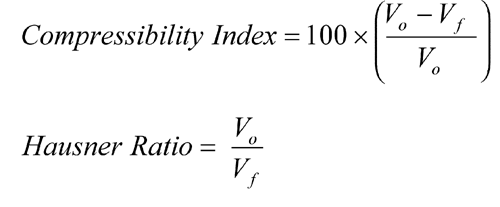
Alternatively,
the compressibility index and Hausner ratio may be calculated using measured
values for bulk density ( bulk) and tapped density (tapped) as follows:
bulk) and tapped density (tapped) as follows: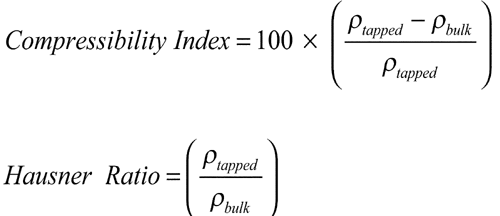
In a
variation of these methods, the rate of consolidation is sometimes measured
rather than, or in addition to, the change in volume that occurs on tapping. For
the compressibility index and the Hausner ratio, the generally accepted scale
of flowability is given in Table*,
|
Compressibility
Index (%) |
Flow
Character
|
Hausner
Ratio
|
 10 10 |
Excellent
|
1.00–1.11
|
|
11–15
|
Good
|
1.12–1.18
|
|
16–20
|
Fair
|
1.19–1.25
|
|
21–25
|
Passable
|
1.26–1.34
|
|
26–31
|
Poor
|
1.35–1.45
|
|
32–37
|
Very poor
|
1.46–1.59
|
|
>38
|
Very, very poor
|
>1.60
|
Experimental Considerations for the Compressibility Index and
Hausner Ratio:
Compressibility index
and Hausner ratio are not intrinsic properties of the powder; i.e., they depend
on the methodology used. In the existing literature, there are discussions of
the following important considerations affecting the determination of (1) the
unsettled apparent volume, Vo, (2) the final tapped
volume, Vf, (3) the bulk density, bulk,
and (4) the tapped density, tapped :
bulk,
and (4) the tapped density, tapped :
·
The diameter of the
cylinder used
·
The number of times the
powder is tapped to achieve the tapped density
·
The mass of material
used in the test
·
Rotation of the sample
during tapping
Recommended Procedure for Compressibility Index and Hausner Ratio
·
Use a 250-mL volumetric
cylinder with a test sample weight of 100 g.
·
Smaller weights and
volumes may be used, but variations in the method should be described with the
results.
·
An average of three
determinations is recommended.
Observations and Calculations of xanthan gum as
polymer:
According to volume:
Initial volume (Vo)
= 100ml
Final volume (Vf) =
75ml
Compressibility index = 100 x [Vo-Vf
/ Vo]
= 100 x [100-75/100]
= 100 x 0.25 = 25%
Hausner ration = Vo/ Vf
= 100/75 = 1.33
According to Density:
Tapped density = 0.62g/ml
Bulk density = 46.5/100 = 0.465g/ml
Compressibility index =
100 x [tapped density-bulk density/tapped density]
=
100 x [0.62-0.465/0.62]
=
100 x 0.25 = 25%
Hausner ratio = tapped density/ bulk
density
= 0.62/0.465 = 1.33
Result:
Ø Compressibility
index of xanthan gum is 25% according to volume r density and Hausner ration is
1.33.According to specification sample is fall in Passable powder range.
Ø Compressibility
index of Tizanidine HCl is 17.07% according to volume and density and Hausner
ratio is 1.21. According to specification drug is fall in Fair powder range.
(14)
|
Compressibility
Index (%) |
Flow
Character
|
Hausner
Ratio
|
|
10 |
Excellent
|
1.00–1.11
|
|
11–15
|
Good
|
1.12–1.18
|
|
16–20
|
Fair
|
1.19–1.25
|
|
21–25
|
Passable
|
1.26–1.34
|
|
26–31
|
Poor
|
1.35–1.45
|
|
32–37
|
Very poor
|
1.46–1.59
|
|
>38
|
Very, very poor
|
>1.60
|
SOLUBILITY
ANALYSIS
Phase-solubility
analysis is the quantitative determination of the purity of a substance through
the application of precise solubility measurements. At a given temperature, a
definite amount of a pure substance is soluble in a definite quantity of
solvent. The resulting solution is saturated with respect to the particular
substance, but the solution remains unsaturated with respect to other
substances, even though such substances may be closely related in chemical
structure and physical properties to the particular substance being tested.
Constancy of solubility, like constancy of melting temperature or other
physical properties, indicates that a material is pure or is free from foreign
admixture except in the unique case in which the percentage composition of the
substance under test is in direct ratio to solubility of the respective
components. Conversely, variability of solubility indicates the presence of an impurity
or impurities.
Solvents
A proper solvent for phase-solubility analysis meets the following
criteria:
1) The
solvent is of sufficient volatility that it can be evaporated under vacuum, but
is not so volatile that difficulty is experienced in transferring and weighing
the solvent and its solutions. Normally, solvents having boiling points between
60 and 150 are suitable.
and 150 are suitable.
2) The solvent does not adversely affect the
substance being tested. Solvents that cause decomposition or react with the
test substance are not to be used. Solvents that solvate or form salts are to
be avoided, if possible.
3) The solvent is of known purity and composition.
Carefully prepared mixed solvents are permissible. Trace impurities may affect
solubility greatly.
4) A solubility of 10 mg to 20 mg per g is optimal,
but a wider working range can be used.
Procedure:
|
Very soluble
|
Less than 1g
|
|
Freely soluble
|
1-10
|
|
Soluble
|
10-30
|
|
Sparingly soluble
|
30-100
|
|
Slightly solube
|
100-1000
|
|
Slightly solube
|
1000-10,000
|
|
Slightly solube
|
More than 10,000
|
·
Take 50ml of purified
water.
·
Add amount of solute and
dissolve it.
·
Continue dissolving
until solute show hinderence to dissolve completely.
·
Temperature rises
gradually up to 85
·
Cool down temperature at
80
·
Pippette out 5ml of
solution and place it into china dish.
·
Solution was cooled at
70,60,50,40,
and 30
,60,50,40,
and 30
·
Evaporate by direct heat
all the pipette out solution, for each temperature
·
Weigh all of residues of
each temperature separately
·
Maintain temperature
solubility profile
·
Calculate solubility of
salt at ;


 80= w3-w1 100
w2-w3
Result:
Xanthan gum is partially insoluble in ethanol and
ether and soluble in warm cold and water.
Tizanidine HCl is soluble in water (20 mg/ml).
(15)
PARTICLE SIZE ANALYSIS
Sieving is one of the
oldest methods of classifying powders and granules by particle size
distribution. When using a woven sieve cloth, the sieving will essentially sort
the particles by their intermediate size dimension (i.e., breadth or width).
Mechanical sieving is most suitable where the majority of the particles are
larger than about 75 µm. For smaller particles, the light weight provides
insufficient force during sieving to overcome the surface forces of cohesion
and adhesion that cause the particles to stick to each other and to the sieve,
and thus cause particles that would be expected to pass through the sieve to be
retained. For such materials, other means of agitation such as air-jet sieving
or sonic sifting may be more appropriate. Nevertheless, sieving can sometimes
be used for some powders or granules having median particle sizes smaller than
75 µm where the method can be validated. In pharmaceutical terms, sieving is
usually the method of choice for classification of the coarser grades of single
powders or granules. It is a particularly attractive method in that powders and
granules are classified only on the basis of particle size, and in most cases
the analysis can be carried out in the dry state.
Estimate the particle
size distribution as described under Dry Sieving Method, unless
otherwise specified in the individual monograph. Sieving should be carried out
under conditions that do not cause the test sample to gain or lose moisture.
SIEVING
METHODS
Mechanical Agitation
Dry Sieving Method:
·
Tare each test sieve to
the nearest 0.1 g.
·
Place an accurately
weighed quantity of test specimen on the top (coarsest) sieve, and replace the
lid. Agitate the nest of sieves for 5 minutes.
·
Then carefully remove
each from the nest without loss of material.
·
Reweigh each sieve, and
determine the weight of material on each sieve.
·
Determine the weight of
material in the collecting pan in a similar manner.
·
Reassemble the nest of
sieves, and agitate for 5 minutes. Remove and weigh each sieve as previously
described.
·
Repeat these steps until
the endpoint criteria are met (see Endpoint Determination under Test
Sieves). Upon completion of the analysis, reconcile the weights of
material.
·
Total losses must not
exceed 5% of the weight of the original test specimen.
·
Repeat the analysis with
a fresh specimen, but using a single sieving time equal to that of the combined
times used above.
·
Confirm that this
sieving time conforms to the requirements for endpoint determination. When this
endpoint has been validated for a specific material, then a single fixed time
of sieving may be used for future analyses, providing the particle size
distribution fall within normal variation.
·
If there is evidence
that the particles retained on any sieve are aggregates rather than single
particles, the use of mechanical dry sieving is unlikely to give good
reproducibility, and a different particle size analysis method should be used.
Result:
By passing sample powder
through sieve number 20, 60, 80 then results are;
·
100% pass through sieve
number 20
·
100% pass through sieve number
60
·
98% pas through sieve
number 80 (16)
DETERMINATION OF
MELTING POINT
“For Pharmacopeial
purposes, the melting range, melting temperature, or melting point is defined
as those points of temperature within which, or the point at which, the first detectable
liquid phase is detected to the temperature at which no solid phase is
apparent”
A melting transition may
be instantaneous for a highly pure material, but usually a range is observed
from the beginning to the end of the process. Factors influencing this
transition include the sample size, the particle size, the efficiency of heat
diffusion, and the heating rate, among other variables, that are controlled by
procedure instructions. In some articles, the melting process is accompanied by
simultaneous decomposition, which is visually evidenced as a side event like
darkening of the material, charring, bubbling, or other incident. The visual
impact of this side reaction frequently obscures the end of the melting
process, which it may be impossible to accurately determine. In those
circumstances, only the beginning of the melting can be accurately established;
and it is to be reported as the melting temperature.
CAPILLARY TUBE METHOD:
Apparatus: A suitable melting range Apparatus consists
of;
·
Glass container for a bath of transparent fluid,
·
A suitable stirring device,
·
An accurate thermometer
·
A controlled source of heat.
·
The bath fluid is selected with a view to the temperature
required, but light paraffin is used generally and certain liquid silicones are
well adapted to the higher temperature ranges.
·
The fluid is deep enough to permit immersion of the thermometer to
its specified immersion depth so that the bulb is still about 2 cm above the
bottom of the bath.
·
The heat may be supplied by an open flame or electrically.
·
The capillary tube is about 10 cm long and 0.8 to 1.2 mm in
internal diameter with walls 0.2 to 0.3 mm in thickness.
Procedure:
·
Reduce the substance under test to a very fine powder, and, unless
otherwise directed, render it anhydrous when it contains water of hydration by
drying it at the temperature specified in the monograph, or, when the substance
contains no water of hydration, dry it over a suitable desiccant for not less
than 16 hours.
·
Charge a capillary glass tube, one end of which is sealed, with a
sufficient amount of the dry powder to form a column in the bottom of the tube
2.5 to 3.5 mm high when packed down as closely as possible by moderate tapping
on a solid surface.
·
Heat the bath until the temperature is about 30 below the expected melting point.
below the expected melting point.
·
Remove the thermometer, and quickly attach the capillary tube to
the thermometer by wetting both with a drop of the liquid of the bath or
otherwise, and adjust its height so that the material in the capillary is level
with the thermometer bulb.
·
Replace the thermometer, and continue the heating, with constant
stirring, sufficiently to cause the temperature to rise at a rate of about 3 per minute. When the temperature is
about 3 below the lower limit of the expected
melting range, reduce the heating so that the temperature rises at a rate of
about 1 to 2 per minute. Continue heating until
melting is complete.
per minute. When the temperature is
about 3 below the lower limit of the expected
melting range, reduce the heating so that the temperature rises at a rate of
about 1 to 2 per minute. Continue heating until
melting is complete.
·
The temperature at which the column of the substance under test is
observed to collapse definitely against the side of the tube at any point
indicates the beginning of melting, and the temperature at which the test
substance becomes liquid throughout corresponds to the end of melting or the
melting point. The two temperatures fall within the limits of the melting
range. If melting occurs with decomposition, the melting temperature
corresponding to the beginning of the melting is within the range specified.
Result:
Melting
point of xanthan gum is 270oC
Melting
point of Tizanidine HCl is 2800 (17)
STABILITY
ANALYSIS
Stability: Stability is defined as the extent to which a
product retains, within specified limits, and throughout its period of storage
and use (i.e., its shelf-life), the same properties and characteristics that it
possessed at the time of its manufacture. Five types of stability generally
recognized are shown in the accompanying table.
DETERMINATION OF STABILITY AGAINST HEAT:
Theory:
Preparation of stable
pharmaceutical product is critical. In every case either prepares alone drug or
combination of drug, drug stability testing at various temperatures, different
humidity level and in exposure of light. These stability parameters are
essential fir asses the stability of drug.
Apparatus:
·
Petri dish
·
Oven
Procedure:
·
Take 2g of powder in a
Petri dish and place in oven at temperature of 450C for 2hours.
·
Calculate the
percentage purity of sample.
DETERMINATION OF STABILITY AGAINST LIGHT:
Theory:
Preparation of stable
pharmaceutical product is critical. In every case either prepares alone drug or
combination of drug, drug stability testing at various temperatures, different
humidity level and in exposure of light. These stability parameters are
essential fir asses the stability of drug.
Apparatus:
·
Petri dish
·
Watch glass
Procedure:
Take some powder in a petri dish
place in sunlight for 2hours. Perform assy if drug is given previously to
calculate the % age purity.
DETERMINATION OF STABILITY AGAINST MOISTURE:
Theory:
Preparation of stable
pharmaceutical product is critical. In every case either prepares alone drug or
combination of drug, drug stability testing at various temperatures, different
humidity level and in exposure of light. These stability parameters are
essential fir asses the stability of drug.
Apparatus:
·
Desicator
·
China dish
Procedure:
·
Take an empty china
dish and weigh it. Now places some powder on it and weighed again.
·
Calculate the weight of
powder and placed in a desicator containing water.
·
Leave the desicator for
2hours and after it took the dish out, weighed the powder again.
·
Calculate net weight
gain from above observation.
Assay:
To study stability calculates %age
purity by performing assay from previous procedure of assay of tizanidine. (18)

2 comments:
are you a teacher in pharmacy institute
Thank you very much for writing such an interesting article on this topic. This has really made me think and I hope to read more.
http://vitalhealthrecipes.com/tizanidine-3/
Post a Comment